This post represents the solution and explanation for quiz #5. Have a look at the quiz to understand the problem.
At first look, the quiz seemed tricky because of OSPFv3/IPv6, but the thing is that the problem/quiz applies to both OSPFv2 and OSPFv3!
As most of you already indicated in the Comments section, the junior engineer did make a mistake: he put/left the Vlan102 interface in area 0.0.0.0 (clearly shown in the output of command “show ipv6 ospf int b“) which makes from Dist-2 router an ABR (Area Border Router).
As most of you already indicated in the Comments section, the junior engineer did make a mistake: he put/left the Vlan102 interface in area 0.0.0.0 (clearly shown in the output of command “show ipv6 ospf int b“) which makes from Dist-2 router an ABR (Area Border Router).
My next question to all of you would be: “so, what?… why an ABR cannot accept that default route received from another ABR (the COREs in our quiz)?” … let’s see why:
We all know that the motivation of having an NSSA is to allow external routes into a Stub area. External routes (learned from different routing domains) are carried within the NSSA area as Type-7 LSAs. As specified in RFC 1587, there are some bits in the Options field that are important in our context:
- N-bit = used in the Hello packets to indicated that the router has NSSA capability on that interface (two routers will not form an ajancency unless they agree on the N-bit, meaning they are both configured as NSSA for that interface)
- P-bit = (P – propagate) only used in type-7 LSAs to tell the ABRs to translate that type-7 LSA into a type-5 LSA. This P-bit is also used as a routing loop prevention mechanism.
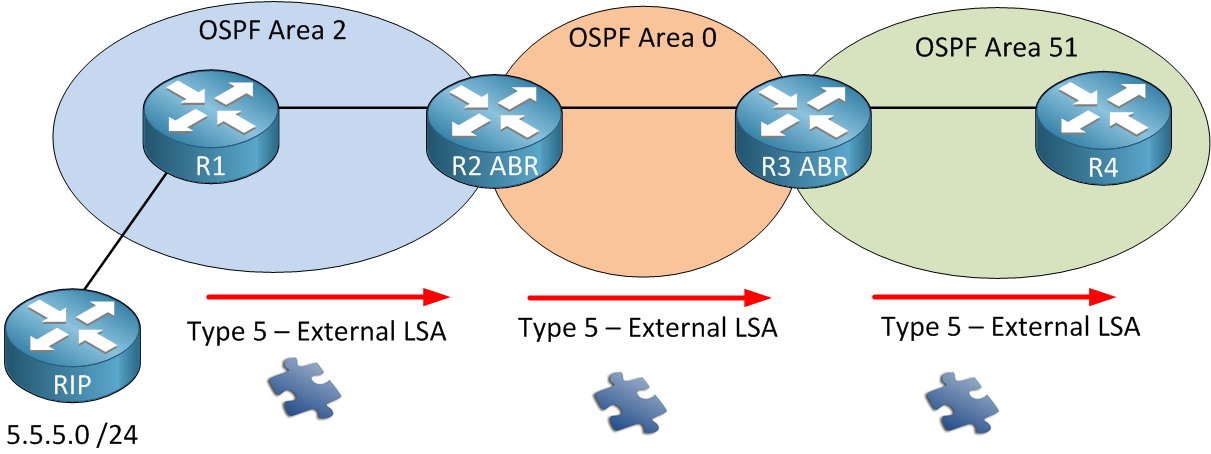
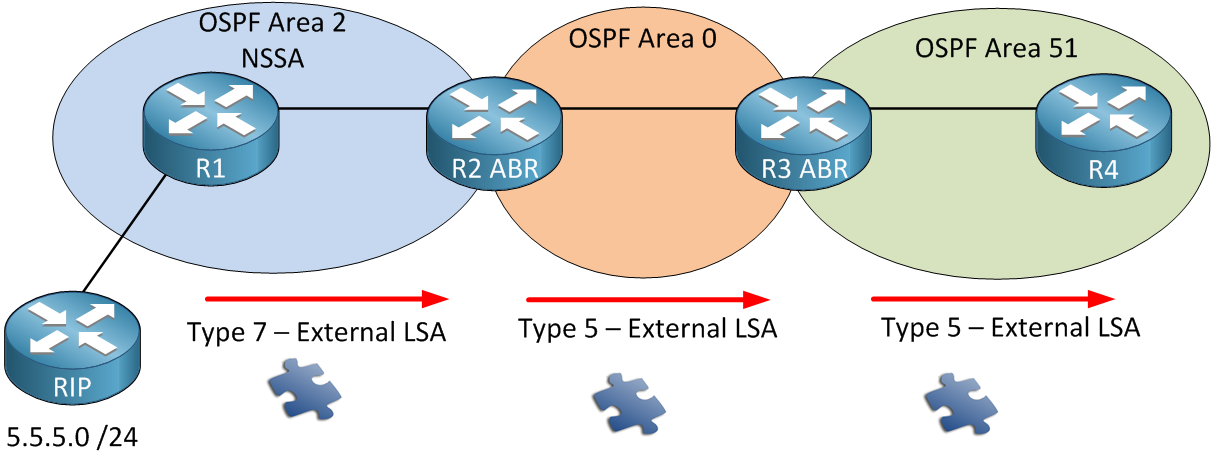
Have a look at the picture below:

On the right-hand side, the ASBR (connected to other routing domains) will send the external prefixes within type-7 LSAs with the P-bit set. These LSAs will be translated into type-5 LSAs on both ABRs.
On the left-hand side, the ABR-1 and ABR-2 (COREs in our quiz) originate type-7 default route and they MUST NOT set the P-bit. When these type-7 LSAs reach other ABRs, since they don’t have the P-bit, they will not be considered for SFP calculations and will not get to the routing table.
Let’s have a look at OSPF’s database on our Dist-2:
Dist-2#sh ipv ospf database
...
                Type-7 AS External Link States (Area 192.168.1.0)

ADV Router      Age         Seq#        Prefix
192.168.255.1   231         0x80000001  ::/0
192.168.255.2   220         0x80000001  ::/0
...
Dist-2#sh ipv ospf database nssa-external

            OSPFv3 Router with ID (192.168.255.4) (Process ID 1)

                Type-7 AS External Link States (Area 192.168.1.0)
| LS age: 263 LS Type: AS External Link Link State ID: 1 Advertising Router: 192.168.255.1 LS Seq Number: 80000001 Checksum: 0x6565 Length: 28 Prefix Address: :: Prefix Length: 0, Options: None Metric Type: 2 (Larger than any link state path) Metric: 1 | LS age: 252 LS Type: AS External Link Link State ID: 1 Advertising Router: 192.168.255.2 LS Seq Number: 80000001 Checksum: 0x5F6A Length: 28 Prefix Address: :: Prefix Length: 0, Options: None Metric Type: 2 (Larger than any link state path) Metric: 1 |
As you can see, Dist-2 knows the two default injected by cores in the OSPF database, but does not put them into the routing table – as an ABR, it does not accept type-7 LSA without P-bit, in order to avoid routing loops.
Now, let’s fix the mistake ( configure area 192.168.1.0 on Vlan102 interface) and check again:
Dist-2(config)#int vlan 102
Dist-2(config-if)#ipv6 ospf 1 area 192.168.1.0
Dist-2(config-if)#end
Dist-2#
Dist-2#sh ipv route ::/0
...
ON2  ::/0 [110/1]
     via FE80::C001:1CFF:FE3C:10, FastEthernet0/1
     via FE80::C000:1CFF:FE3C:10, FastEthernet0/0
Dist-2#
| Dist-2#sh ipv osp int b
Interface PID Area Intf ID Cost State Nbrs F/C
Vl102 1 192.168.1.0 30 1 DR 0/0
Vl201 1 192.168.1.0 35 1 DR 0/0
Vl200 1 192.168.1.0 34 1 DR 0/0
Vl105 1 192.168.1.0 33 1 DR 0/0
Vl104 1 192.168.1.0 32 1 DR 0/0
Vl103 1 192.168.1.0 31 1 DR 0/0
Vl101 1 192.168.1.0 29 1 DR 0/0
Vl100 1 192.168.1.0 28 1 DR 0/0
Fa0/1 1 192.168.1.0 5 1 DR 1/1
Fa0/0 1 192.168.1.0 4 1 DR 1/1
Lo0 1 192.168.1.0 27 1 LOOP 0/0
|
you’ll notice the additional information “Routing Bit Set on this LSA” (that did not exist before !!). This is a Cisco implementation to indicate that the LSA is valid (passed all sanity checks) for SFP calculation (please note that this “routing-bit” is not an actual bit in the LSA Option field, it is stored only locally, not propagated to other OSPF routers).
In the end, let’s have a look how a type-7 LSA with P-bit SET looks like: suppose ASBR (Dist-1 in our case) redistributes the external prefix 2003:1:1:1::/64
Dist-2#sh ipv route 2003:1:1:1::/64
...
ON2  2003:1:1:1::/64 [110/20]
     via FE80::C001:1CFF:FE3C:10, FastEthernet0/1
     via FE80::C000:1CFF:FE3C:10, FastEthernet0/0
Dist-2#
Dist-2#sh ipv ospf database nssa-external
...
  Routing Bit Set on this LSA
  LS age: 42
  LS Type: AS External Link
  Link State ID: 2
  Advertising Router: 192.168.255.3
  LS Seq Number: 80000001
  Checksum: 0x89B4
  Length: 36
  Prefix Address: 2003:1:1:1::
  Prefix Length: 64, Options: P
  Metric Type: 2 (Larger than any link state path)
  Metric: 20
As you can see, this type-7 LSA will be flooded into entire NSSA area and it has the P-bit set (also notice the “Routing Bit Set on this LSA”).
Thanks everyone for your comments into the quiz !

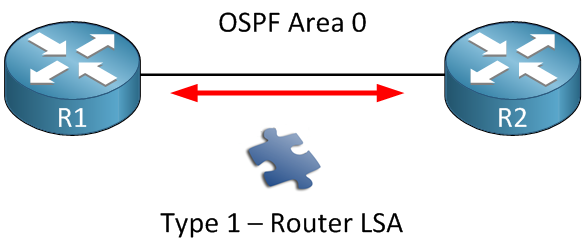
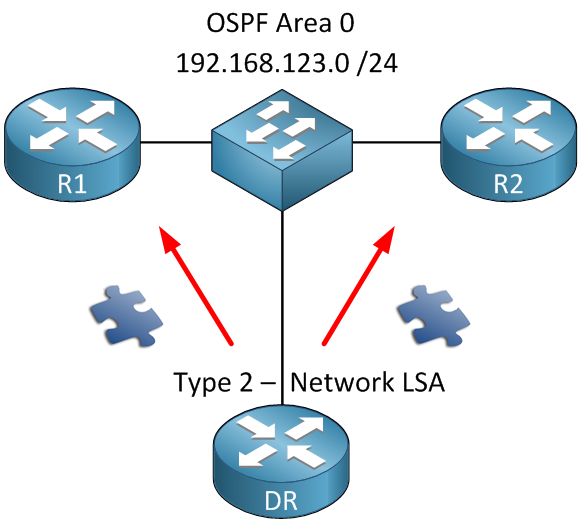
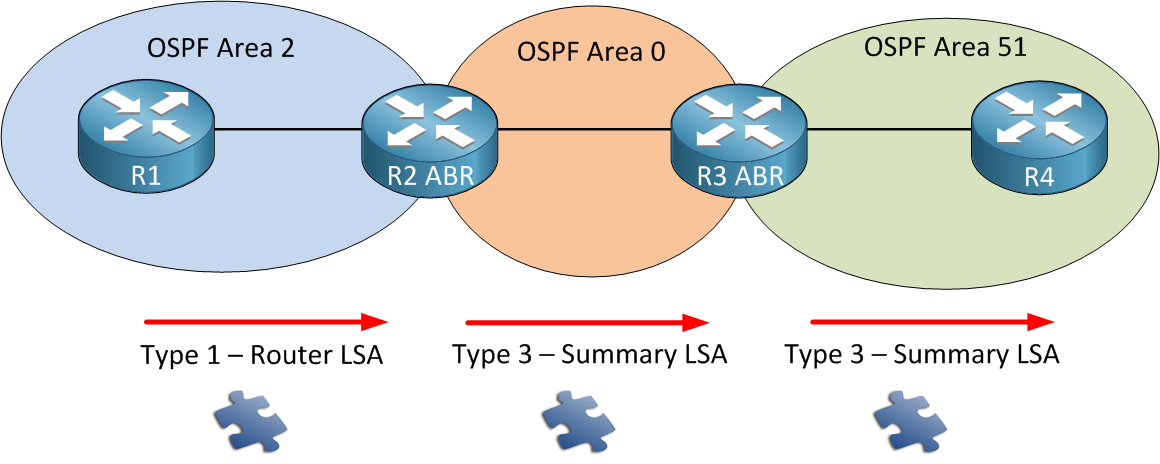
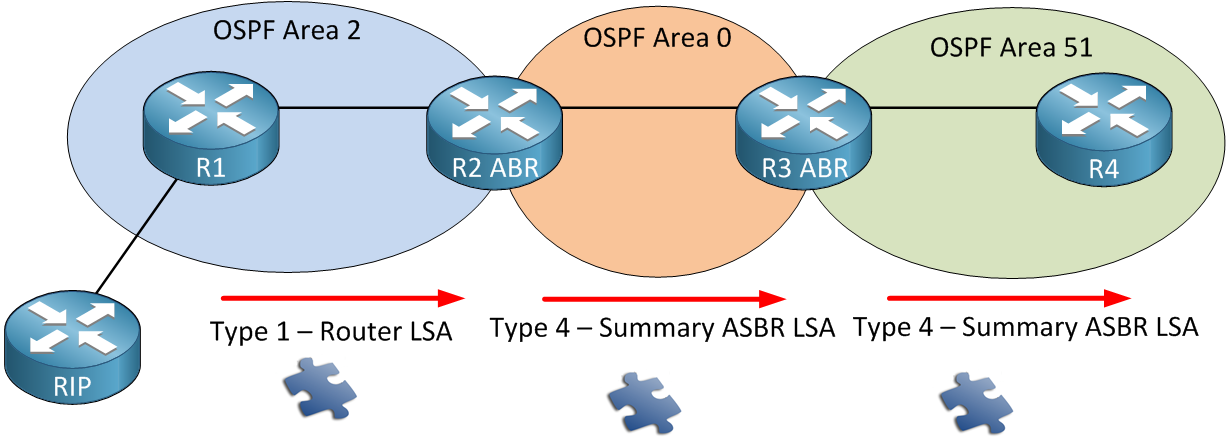 In this example we have R1 that is redistributing information from the RIP router into OSPF. This makes R1 an ASBR (Autonomous System Border Router). What happens is that R1 will flip a bit in the router LSA to identify itself as an ASBR. When R2 who is an ABR receives this router LSA it will create a type 4 summary ASBR LSA and flood it into area 0. This LSA will also be flooded in all other areas and is required so all OSPF routers know where to find the ASBR.